

The conference Energy security - Lessons from Ukraine
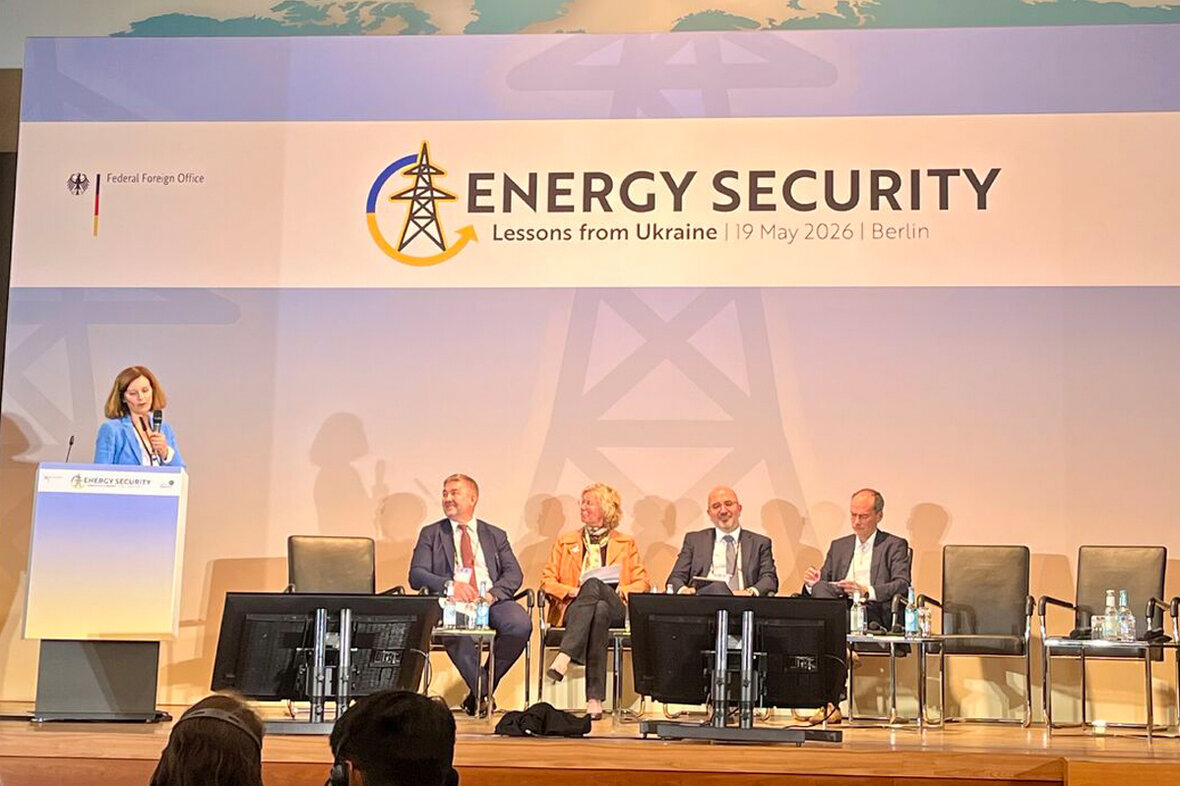
Yesterday in Berlin, high-level representatives from governments, international organisations, TSOs, industry, municipalities, and civil society came together to discuss a question that has become central not only for Ukraine, but for Europe as a whole: what does energy security mean in times of war and systemic crises?
The conference "Energy security - Lessons from Ukraine", organised and hosted by the Auswärtiges Amt (Federal Foreign Office) Germany, opened with remarks by German Federal Foreign Minister Dr Johann Wadephul and a keynote speech by Denys Shmyhal, First Deputy Prime Minister and Minister of Energy of Ukraine, setting the tone for a day focused on resilience, preparedness, reconstruction, and long-term European energy security.
The discussions clearly demonstrated that energy security in Europe can no longer be understood only through the lens of diversification. Ukraine’s experience has brought new dimensions to the forefront: resilience, decentralisation, rapid recovery capacity, protection of critical infrastructure, cyber security, flexibility, and preparedness.
Among the high-level participants were Parliamentary State Secretary Stefan Rouenhoff (Germany), Deputy Prime Minister and Minister of Foreign Affairs of Moldova, NATO Assistant Secretary General, Deputy Minister of Natural Resources of Canada, Secretary of State of Poland, as well as leaders of key energy companies and institutions, including DTEK, Ukrenergo, Naftogaz, 50Hertz, ENTSO-E, the European Commission, the Energy Community Secretariat, and many others.
A recurring message throughout the day was that speed, coordination, and decentralisation are becoming central pillars of modern energy security. Ukraine’s experience is increasingly shaping broader European discussions on crisis preparedness and resilience of critical infrastructure.
Particularly important were the discussions linked to the G7+ Energy Coordination Group and the Ukraine Energy Support Fund. As highlighted during the meetings, international coordination, rapid delivery mechanisms, and strategic reserves of critical equipment remain essential ahead of the next winter season. The Fund, supported by 38 donors, with €670 million mobilised since November 2025, has become one of the key instruments sustaining Ukraine’s energy system under wartime conditions.
GDU/Helmholtz-Zentrum Berlin delegation participated in the discussions, with Dr Susanne Nies moderating the panel on “Energy Security by System Resilience”, focused on lessons learned from protecting and operating the Ukrainian electricity system under repeated attacks. The discussion brought together representatives from the German Federal Ministry for Economic Affairs and Energy, ENTSO-E, Ukrenergo, and Stromnetz Berlin.
A very intense, timely, and important exchange, and another reminder that Ukraine today is not only receiving support, but also shaping Europe’s understanding of energy resilience.